
Buying an old golf cart can be exciting.
Maybe you’ve found an older Club Car, E-Z-GO, or Yamaha that’s been sitting in a garage, shed, or backyard. Maybe you picked it up inexpensively because you could see the potential.
Then you start looking at all the golf cart parts available today.
Wheels and tires. Seats. Lift kits. Motors. Controllers. Lithium batteries. Body kits. Rear seat kits. Sound systems. Digital screens. Lights and dozens of other accessories.
Before long, that inexpensive golf cart can start looking like a very expensive project.
I’ve seen this happen many times.
As someone who works with golf cart owners and helps customers decide which parts and upgrades make sense, my advice is simple: don’t start buying parts until you know what you want the golf cart to become.
The best golf cart parts aren’t necessarily the most expensive parts. They’re the parts that make sense for the golf cart, your budget, and how you intend to use it.
Start by Deciding If the Golf Cart Is Worth Restoring
Before spending money on aftermarket golf cart parts, take a good look at the cart sitting in front of you.
The first question isn’t, “What should I upgrade?”
It’s:
“Is this golf cart worth restoring?”
That doesn’t necessarily mean determining its resale value. It means determining how much value the golf cart has to you and your family.
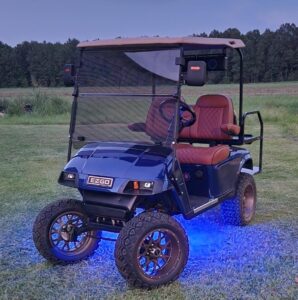
An old golf cart can be a great project. If you’re looking for something fun to work on, something unique to drive around the neighborhood, or a vehicle your family can enjoy together, there’s nothing wrong with putting money into it.
But you need to understand what you’re doing.
You’re investing in something you’re going to enjoy, not necessarily something you’re going to make money on.
One of the biggest mistakes I see is people assuming that every dollar they put into an old golf cart will increase its resale value by a dollar.
That’s generally not how it works.
You can put several thousand dollars into a golf cart and end up with a vehicle that looks and performs dramatically better. But if you sell it later, you shouldn’t automatically expect to recover everything you’ve invested.
If you’re building the cart as a hobby and you have the budget, that’s fine. Build the golf cart you want.
Just make sure you understand that you’re paying for the enjoyment of owning and using the finished product.
Decide How You’ll Use the Golf Cart
The purpose of the golf cart should determine what you buy.
I generally break golf cart upgrades into five categories:
- Wheels, tires, and suspension
- Motors, controllers, and power sources
- Seats and rear seat kits
- Body kits
- Accessories
Not every golf cart needs everything in those categories.
A golf cart used to putter around a campground has very different requirements from one being used as a family transportation vehicle, an agricultural vehicle, or an off-road hunting cart.
Before buying parts, ask yourself:
- Where will I drive the golf cart?
- How many people will it regularly carry?
- How far do I need it to travel?
- Do I need more speed?
- Will I be driving on hills or rough terrain?
- Am I restoring it for practical use or primarily for fun?
Those answers will tell you far more about what parts you need than a catalog ever will.
Wheels and Tires Are Usually the Best Place to Start
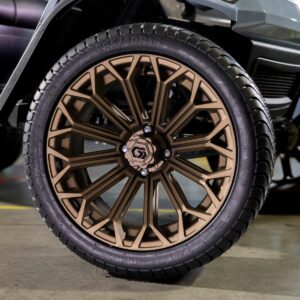
If someone comes to me with an older golf cart and asks where they should start, one of my first recommendations is usually wheels and tires.
There’s a good reason.
Wheels and tires can completely change the appearance of an older golf cart without requiring a complicated mechanical project.
They’re also often among the first components to show their age.
Weather is a huge factor.
Sun, heat, rain, humidity, and everyday use can be hard on tires. If you’re looking at a golf cart that’s 10, 15, 20, or even 30 years old, there’s a good chance the original tires have seen better days.
A new set of wheels and tires gives you an immediate visual upgrade while also addressing an important safety and maintenance issue.
Why Wheels and Tires Are a Great Beginner Upgrade
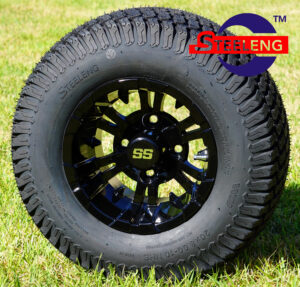
A basic wheel installation is something many golf cart owners can handle themselves.
Most golf cart wheels use a simple four-bolt pattern, and with a socket set, a jack, and some basic mechanical common sense, changing them isn’t an especially complicated project.
Depending on the wheels and tires you choose, you can often make a major improvement for around $500 to $700.
For a beginner working with a limited budget, that’s a pretty good return.
You’re not rebuilding the drivetrain or modifying the electrical system. You’re simply replacing one of the most visible and commonly worn parts of the golf cart.
If you’d like to see what’s available, you can browse golf cart wheels and tires at CreativeCartz.
Replace Worn-Out Seats
After wheels and tires, seats are another economical way to transform an older golf cart.
Again, weather plays a major role.
The seats on an older cart may have spent years exposed to sunlight, moisture, dirt, and temperature changes. Even if the golf cart is mechanically sound, worn-out seats can make the entire vehicle feel old.
I’ve seen this particularly with older golf carts from the late 1980s, 1990s, and early 2000s.
A golf cart that’s 20 or 30 years old can still be perfectly usable, but the seats have been dealing with the elements for decades.
Replacing the main seat—and the rear seats if the cart has a rear seat kit—can make a surprisingly big difference.
Why Seats Make Sense on a Limited Budget
Let’s say you’ve got a $2,000 budget.
If you spend $500 to $700 on wheels and tires, you’ve already used a significant portion of that money. You’re not going to completely restore an old golf cart with the remaining budget.
That’s where prioritizing becomes important.
I’d rather see a customer make a couple of meaningful upgrades than try to do five different things halfway.
New seats improve the appearance and comfort of the golf cart without requiring a major mechanical modification.
You can look at replacement golf cart seats and rear seating options at CreativeCartz.
Don’t Forget About the Batteries
When you’re buying an older golf cart, the battery situation needs to be part of your restoration budget from the beginning.
You can’t assume that the batteries are going to be new or that they’re going to have plenty of life left.
In fact, when you’re buying a used golf cart, I’d recommend assuming that a battery replacement could eventually become part of the project.
And that applies whether you stay with lead-acid batteries or move to lithium.
A battery replacement can dramatically change the total cost of restoring an older golf cart, so don’t leave it out of your calculations.
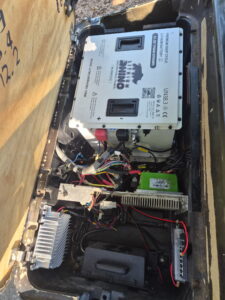
Lithium Batteries Can Transform an Older Golf Cart
If the budget allows for a larger upgrade, one of my favorite recommendations is replacing lead-acid batteries with a lithium battery system.
This isn’t just a cosmetic upgrade.
You’re changing the way the golf cart operates.
Lead-acid batteries require regular maintenance and generally don’t offer the same convenience and lifespan as modern lithium systems.
Lithium batteries also have a major weight advantage.
Removing a heavy bank of lead-acid batteries and replacing it with a lithium battery bundle can take a substantial amount of weight out of the golf cart. That reduction in weight can help the cart perform better and can contribute to increased speed and efficiency.
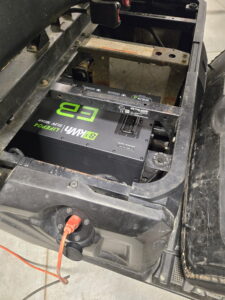
Choosing the Right Lithium Battery Capacity
Bigger isn’t automatically better when it comes to lithium batteries.
The right capacity depends on how you use the golf cart.
Amp-hours help determine how much energy the battery can store and, consequently, how much distance you can potentially travel between charges.
If you’re simply driving around a campground, going to the mailbox, or making short neighborhood trips, you may not need an enormous battery.
On the other hand, if you’re playing multiple rounds of golf every week and don’t want to worry about charging constantly, a larger battery makes more sense.
There are lithium bundles available in different capacities, including options around 60 amp-hours, 105 amp-hours, 160 amp-hours, and even higher.
The important thing is to match the battery to your actual needs.
You can explore lithium golf cart battery bundles at CreativeCartz.
Motors and Controllers: When Performance Matters
The first question I hear from many golf cart owners is:
“How do I make it go faster?”
That’s where motors and controllers come into the conversation.
Motor and controller upgrades can be an excellent investment when performance is genuinely part of the purpose of the golf cart.
They’re designed to improve performance, including speed and, depending on the system, braking and overall control.
But I wouldn’t automatically recommend starting with a motor and controller.
If you’re replacing lead-acid batteries with lithium, the weight reduction alone can improve how the golf cart performs.
Some models can also have their speed adjusted electronically through programming or codes, depending on the vehicle and controller system.
So before spending money on a high-performance motor and controller, determine whether you actually need one.
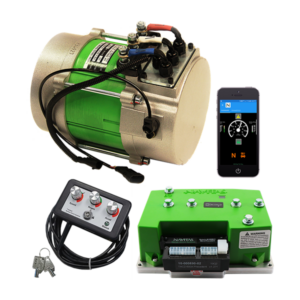
When Should You Upgrade the Motor and Controller?
A motor and controller upgrade makes more sense when you need additional performance.
Maybe you’re dealing with hills.
Maybe you regularly carry several passengers.
Maybe you want more acceleration.
Or perhaps you’re building a golf cart that you’re going to use as a legitimate second vehicle for your household.
Some customers want to use their golf carts for trips to the grocery store, taking the kids to school, or other regular transportation.
That’s a very different use case from someone who drives around a campground.
The upgrade needs to match the use.
You can explore golf cart motors and controllers at CreativeCartz.
Do You Really Need a Lift Kit?
Here’s one area where my opinion may be different from what you see in a lot of golf cart marketing.
A lift kit is often one of the least important upgrades for the average golf cart owner.
That doesn’t mean lift kits aren’t useful.
They absolutely have their place.
A lift kit allows you to install larger wheels and tires and gives the golf cart a completely different appearance.
But if you’re working with a limited budget, I wouldn’t necessarily put a lift kit at the top of the list.
When a Lift Kit Makes Sense
If you’re using the golf cart for agricultural purposes, driving around pasture or rough property, or building a hunting vehicle, additional ground clearance can be extremely useful.
That’s a functional upgrade.
If you simply want a lifted golf cart because you like the appearance, that’s more of an aesthetic decision—and there’s nothing wrong with that.
If you have the budget and that’s the look you want, go for it.
Just remember that a lifted golf cart can introduce safety considerations, particularly when you’re also increasing its speed.
A golf cart that sits higher and travels faster won’t necessarily handle the same way the stock vehicle did.
You can browse golf cart lift kits at CreativeCartz.
Rear Seat Kits Add Practicality
If your golf cart regularly carries additional passengers, a rear seat kit can be a worthwhile upgrade.
For a family, a rear seat kit can dramatically increase the usefulness of the golf cart.
But once again, think about your purpose.
If you’re building a two-seat neighborhood cruiser, you may not need one.
If you’re regularly carrying family and friends, seating becomes much more important.
The same principle applies throughout the entire restoration: buy the part because it solves a problem or accomplishes a goal, not simply because it’s available.
Creative Cartz offers numerous rear seat kit options for you to consider.
Body Kits Can Transform an Older Golf Cart
Once you’ve addressed the fundamentals, a body kit can completely change the appearance of an older golf cart.
You might have a mechanically sound vehicle underneath, but the original body can make it look dated.
A body kit allows you to personalize the golf cart and give it a more modern, sporty, or aggressive appearance.
But if you’re working with a limited budget, I’d still put body work behind the fundamentals.
There’s not much point in putting a beautiful body on a golf cart with worn-out tires, bad seats, failing batteries, or mechanical problems.
Get the important stuff right first.
Save Accessories for Last
Once the golf cart is mechanically sound and you’re happy with its basic appearance, then you can have some fun with accessories.
Depending on the cart, that could include:
- Sound systems
- Digital screens
- Lighting
- Storage
- Mirrors
- Steering wheels
- Dash accessories
- USB charging
- Beverage holders
This is where you can really make the golf cart your own.
But accessories shouldn’t take priority over the components that determine whether the golf cart is actually useful.
A great sound system doesn’t fix a bad battery.
A digital screen doesn’t fix worn-out tires.
And an expensive accessory package doesn’t make up for a golf cart that can’t perform the way you need it to.
Once you’ve taken care of the important upgrades, you can browse golf cart accessories at CreativeCartz and start personalizing the finished product.
My Recommended Order for a Beginner
If you’ve just purchased an older golf cart and aren’t sure where to begin, this is the general order I’d recommend:
1. Determine the Cart’s Value
Look at the age, condition, model, drivetrain, batteries, and overall structure.
Decide whether the golf cart is worth restoring and how much you’re comfortable spending.
2. Decide How You’ll Use It
Is it a campground vehicle, neighborhood cruiser, family transportation vehicle, golf cart, agricultural vehicle, or hunting vehicle?
Your intended use should determine your upgrades.
3. Replace Worn-Out Tires
They’re often one of the easiest and most economical ways to make an older golf cart look and feel better.
4. Replace the Seats
If the seats have spent years exposed to the weather, there’s a good chance they’re ready for replacement.
5. Evaluate the Batteries
Don’t ignore the battery situation. Determine whether the existing batteries have useful life left or whether replacement needs to be included in the budget.
6. Consider Lithium
If your budget allows, lithium can be one of the best overall upgrades you can make to an older golf cart.
7. Evaluate the Motor and Controller
If you need additional speed, acceleration, hill-climbing ability, or overall performance, this is where motor and controller upgrades can make sense.
8. Consider a Lift Kit
Do you actually need additional ground clearance?
If so, a lift kit can be an excellent functional upgrade. If you simply like the look, that’s fine too—but recognize that it’s primarily an aesthetic decision.
9. Add the Body and Accessories
Once the important mechanical and functional components are addressed, then you can start making the golf cart uniquely yours.
The Best Golf Cart Part Is the One That Solves Your Problem
Golf cart customization can become a rabbit hole very quickly.
There are always bigger batteries, faster motors, larger wheels, taller lift kits, different seats, body kits, sound systems, digital screens, lighting, and other accessories to consider.
That’s part of what makes it fun.
But you don’t need to turn every old golf cart into a $15,000 custom build.
Start with what the cart needs.
Then look at what you want.
Most of my customers who are reviving an older golf cart start with wheels and tires because they’re often some of the first components to deteriorate from age and weather. They’re relatively economical, they’re easy to install, and they can dramatically improve the appearance of the cart.
From there, seats are often the next logical step.
If the budget allows, lithium batteries can completely change the ownership experience.
Then, depending on how the cart will be used, you can start looking at motors, controllers, suspension, lift kits, body kits, and accessories.
The important thing is to have a plan.
Is the Juice Worth the Squeeze?
At the end of the day, that’s the question I encourage every customer to ask.
Is the juice worth the squeeze?
If you have an old golf cart and you’re going to enjoy turning it into something unique for your family, then absolutely.
If it’s a hobby and you understand that you’re probably not going to recover every dollar you put into it when you eventually sell it, that’s okay.
You’re paying for the enjoyment of owning and using the finished product.
But if you’re looking at an old golf cart strictly as an investment, I’d be much more cautious.
Before you start ordering parts, figure out what the cart is worth, what you want it to do, and how much you’re willing to spend.
Then build it accordingly.
The best golf cart isn’t necessarily the one with the biggest motor, largest battery, tallest lift, or most expensive wheels.
It’s the one that does exactly what you need it to do—and gives you and your family a reason to enjoy driving it.
Final Thoughts
Restoring an old golf cart doesn’t have to be overwhelming.
Start small.
Start with the things that make the biggest difference.
For most older golf carts, that means looking closely at the tires, wheels, seats, and batteries before getting carried away with performance modifications and accessories.
From there, build according to your purpose.
If you want more speed, look at the motor and controller.
If you need more range, look at your battery capacity.
If you’re driving through rough terrain, consider a lift kit.
If you’re carrying more passengers, look at seating.
And if you simply want the coolest-looking golf cart in the neighborhood, have some fun with the body, wheels, tires, and accessories.
That’s the beauty of golf carts.
You can build them almost any way you want.
Just make sure you’re building the golf cart you actually need—and not simply buying parts because they look good on somebody else’s cart.
If you’re ready to start planning your project, browse the golf cart parts and accessories at CreativeCartz and start with the upgrades that make the most sense for your golf cart, your budget, and the way you plan to use it.